Skip to content

Featured plate · Macro ·

Fed timeline: 5.25%-5.50% ranks second
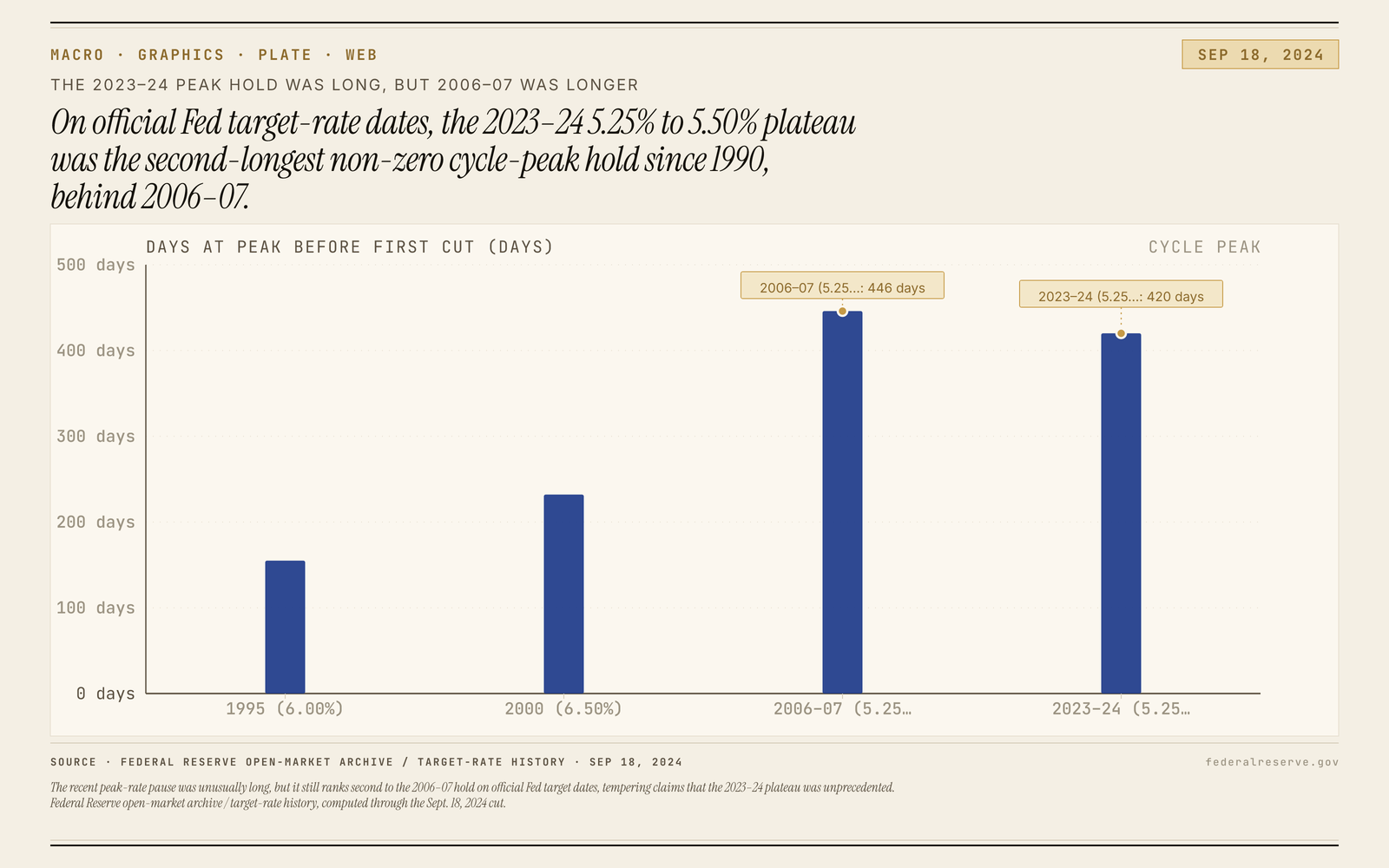
Bar chart showing calendar days the Fed held each post-1990 non-zero cycle peak before the first cut. The bars are 155 days for 1995 at 6.00%, 232 days for 2000 at 6.50%, 446 days for 2006–07 at 5.25%, and 420 days for 2023–24 at 5.25% to 5.50%. The highest bar is 2006–07, so the recent plateau was long but not the longest on official target-rate dates.

A pause at the top can look unprecedented until each peak is measured on the Fed’s own target-rate dates.
Open the plate

The Gallery
  1. Bar chart showing calendar days the Fed held each post-1990 non-zero cycle peak before the first cut. The bars are 155 days for 1995 at 6.00%, 232 days for 2000 at 6.50%, 446 days for 2006–07 at 5.25%, and 420 days for 2023–24 at 5.25% to 5.50%. The highest bar is 2006–07, so the recent plateau was long but not the longest on official target-rate dates.
    Plate 11

    Fed timeline: 5.25%-5.50% ranks second

    A pause at the top can look unprecedented until each peak is measured on the Fed’s own target-rate dates.

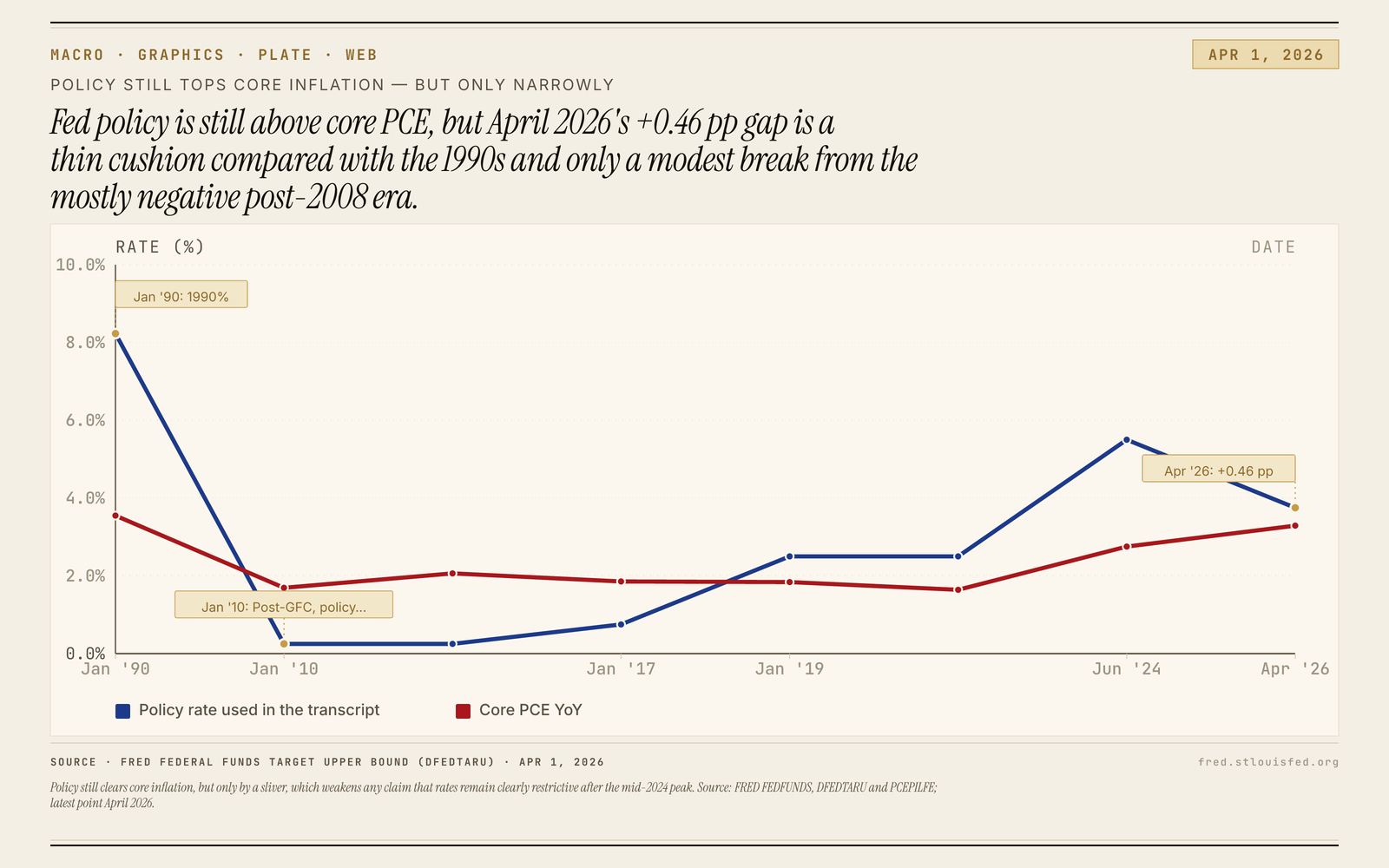
  2. Two-line chart of the policy rate used in the transcript versus core PCE at selected benchmark months since 1990. The policy line sits far above core PCE in the early 1990s, drops below it through much of the post-GFC stretch, jumps well above it in mid-2024, and ends just slightly above core PCE in April 2026; the implied gap is +0.46 pp now versus +2.75 pp in Jun 2024, with the post-GFC era averaging roughly -1.2 pp.
    Plate 10

    Policy Rate Barely Tops Core PCE

    The chart shows the policy rate still above core PCE by +0.46 pp.
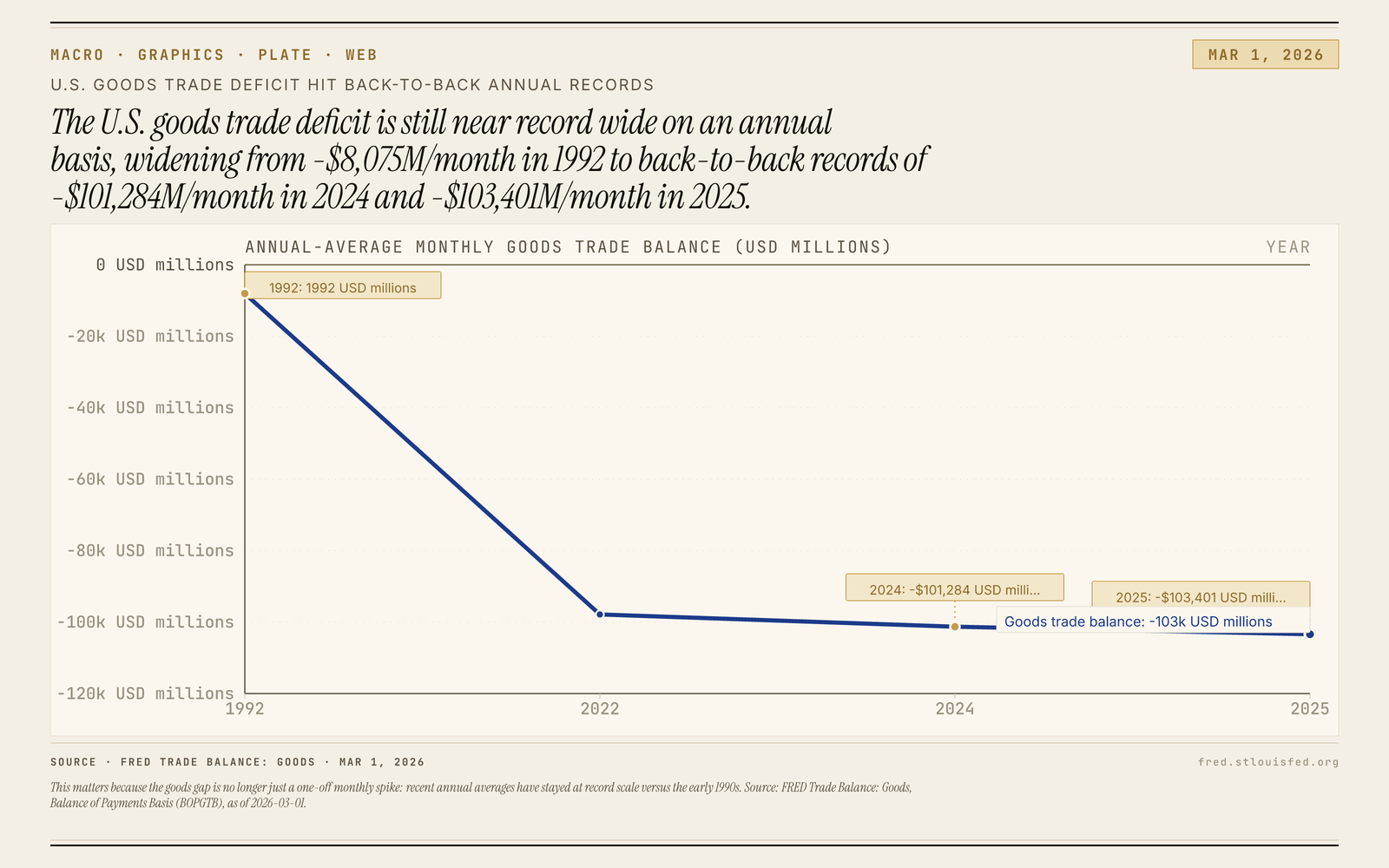
  3. Line chart of selected annual-average monthly U.S. goods trade deficits. The series moves from -$8,075M/month in 1992 to -$97,880M/month in 2022, then to record averages of -$101,284M/month in 2024 and -$103,401M/month in 2025, showing the deficit remains near its widest annual levels in the series.
    Plate 09

    Goods deficit near annual records

    This chart shows the U.S.
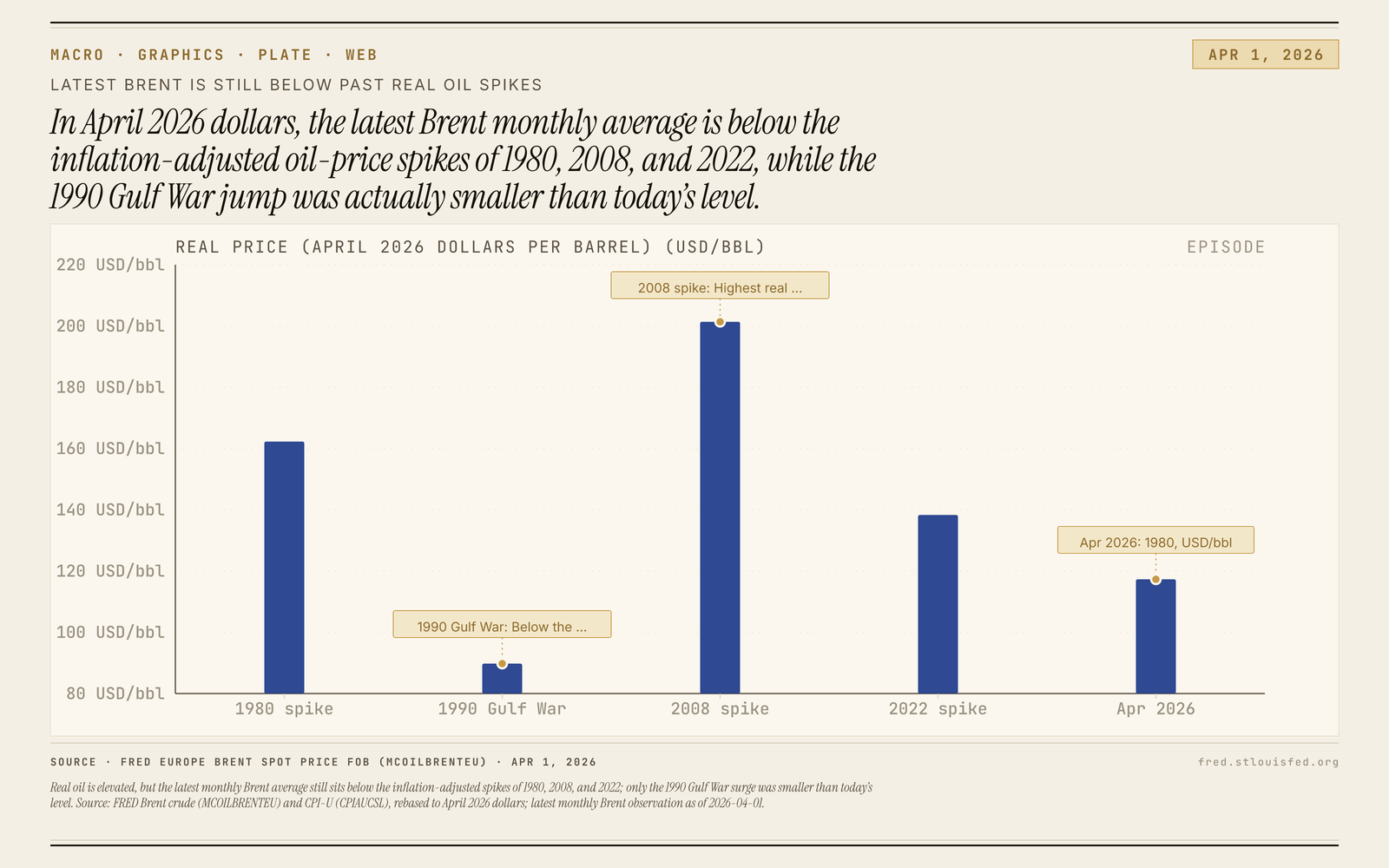
  4. Bar chart comparing selected inflation-adjusted oil-price episodes in April 2026 dollars per barrel. The bars show 1980 at 162.28, 1990 Gulf War at 89.78, 2008 at 201.38, 2022 at 138.3, and April 2026 at 117.29. The latest level is below 1980, 2008, and 2022, but above the 1990 spike.
    Plate 08

    Real Brent Below Prior Oil Shock Peaks

    This chart puts selected oil shocks on the same constant-dollar yardstick, comparing the latest Brent monthly average with earlier crisis episodes rather than live spot headlines.
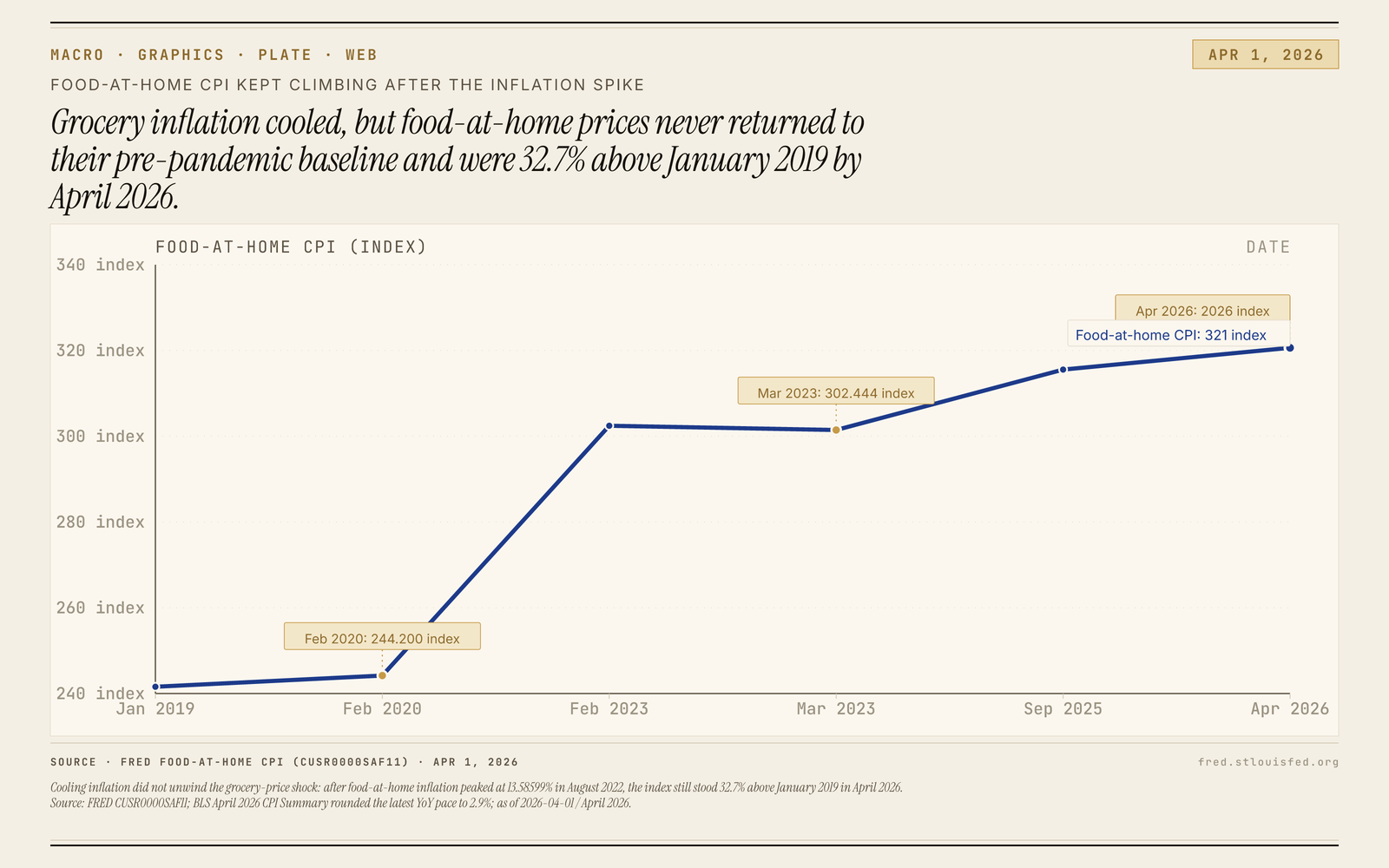
  5. Line chart of the food-at-home CPI showing the price level rising from 241.581 in January 2019 to 320.633 in April 2026, with only a brief dip from 302.444 to 301.467 in February to March 2023 before new highs; it shows that grocery inflation cooled but the higher price level did not reverse.
    Plate 07

    Grocery inflation cooled. Prices stayed high.

    This chart shows grocery prices staying high even after inflation cooled: the food-at-home CPI rose from 244.200 before the pandemic to 320.633, and the brief dip from 302.444 to 301.467 did not last (fred.stlouisfed.org).
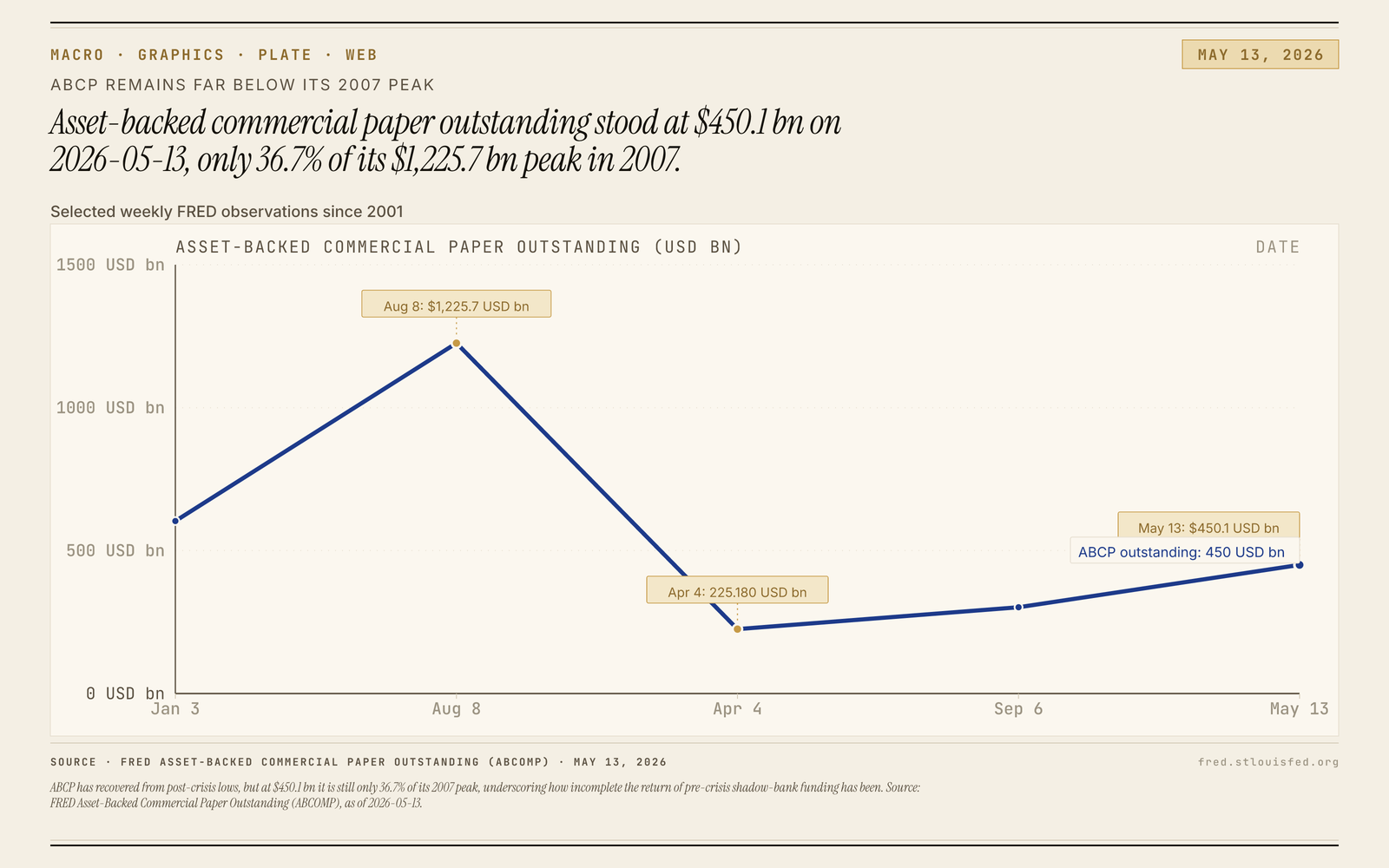
  6. Line chart of selected weekly FRED ABCOMP readings since 2001. ABCP starts at 603.344 on 2001-01-03, peaks at 1,225.668 on 2007-08-08, falls to 225.180 on 2018-04-04, rises to 301.828 on 2023-09-06, and reaches 450.078 on 2026-05-13. The latest level is 36.7% of the 2007 peak, showing only a partial recovery rather than a return to pre-crisis scale.
    Plate 06

    ABCP is still just 36.7% of peak

    This chart shows asset-backed commercial paper outstanding at $450.1 bn, only 36.7% of its $1,225.7 bn peak, according to FRED’s Asset-Backed Commercial Paper Outstanding series (fred.stlouisfed.org).
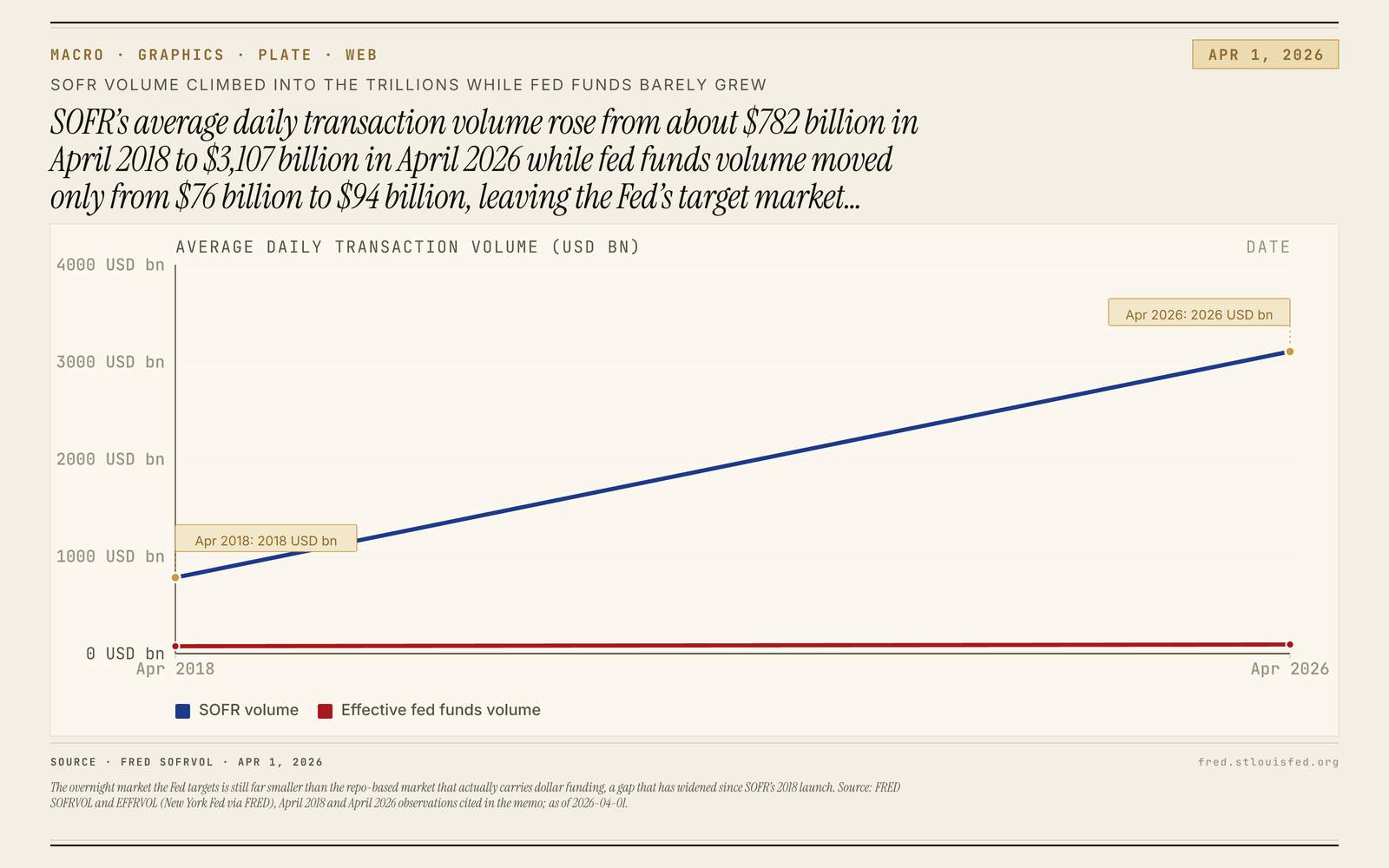
  7. A two-line chart comparing April average daily transaction volume in billions of U.S. dollars. SOFR rises sharply from 782 in April 2018 to 3107 in April 2026, while effective fed funds edges up from 76 to 94, showing that the repo-based market underlying SOFR is vastly larger than fed funds.
    Plate 05

    SOFR Volume Towers Over Fed Funds

    The chart shows SOFR far above fed funds in average daily transaction volume, from $782 billion versus $76 billion at the chart’s opening April average to $3,107 billion versus $94 billion at its latest April average, using New York Fed data via FRED (fred.stlouisfed.org ; fred.stlouisfed.org).
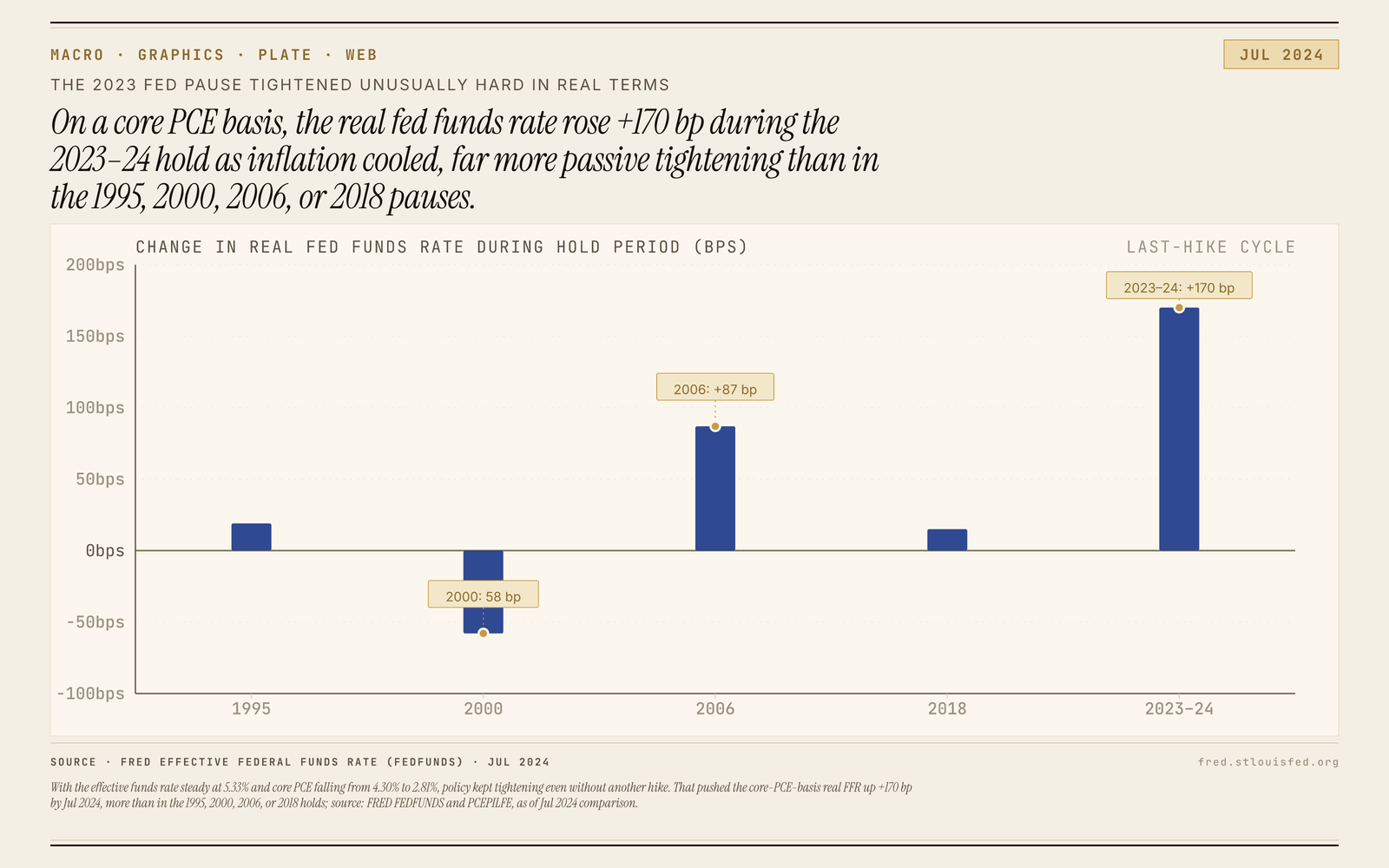
  8. Bar chart comparing passive change in the core-PCE-basis real fed funds rate during hold periods after the last hike. The bars show 1995 at +19 bps, 2000 at −58 bps, 2006 at +87 bps, 2018 at +15 bps, and 2023–24 at +170 bps, the highest by a wide margin; annotations note that the 2023–24 real rate rose from +0.82% to +2.52%.
    Plate 04

    Fed pause kept tightening in real terms

    The chart shows the real fed funds rate climbing during the latest hold as inflation cooled, with the effective rate at 5.33% and core PCE falling from 4.30% to 2.81%.
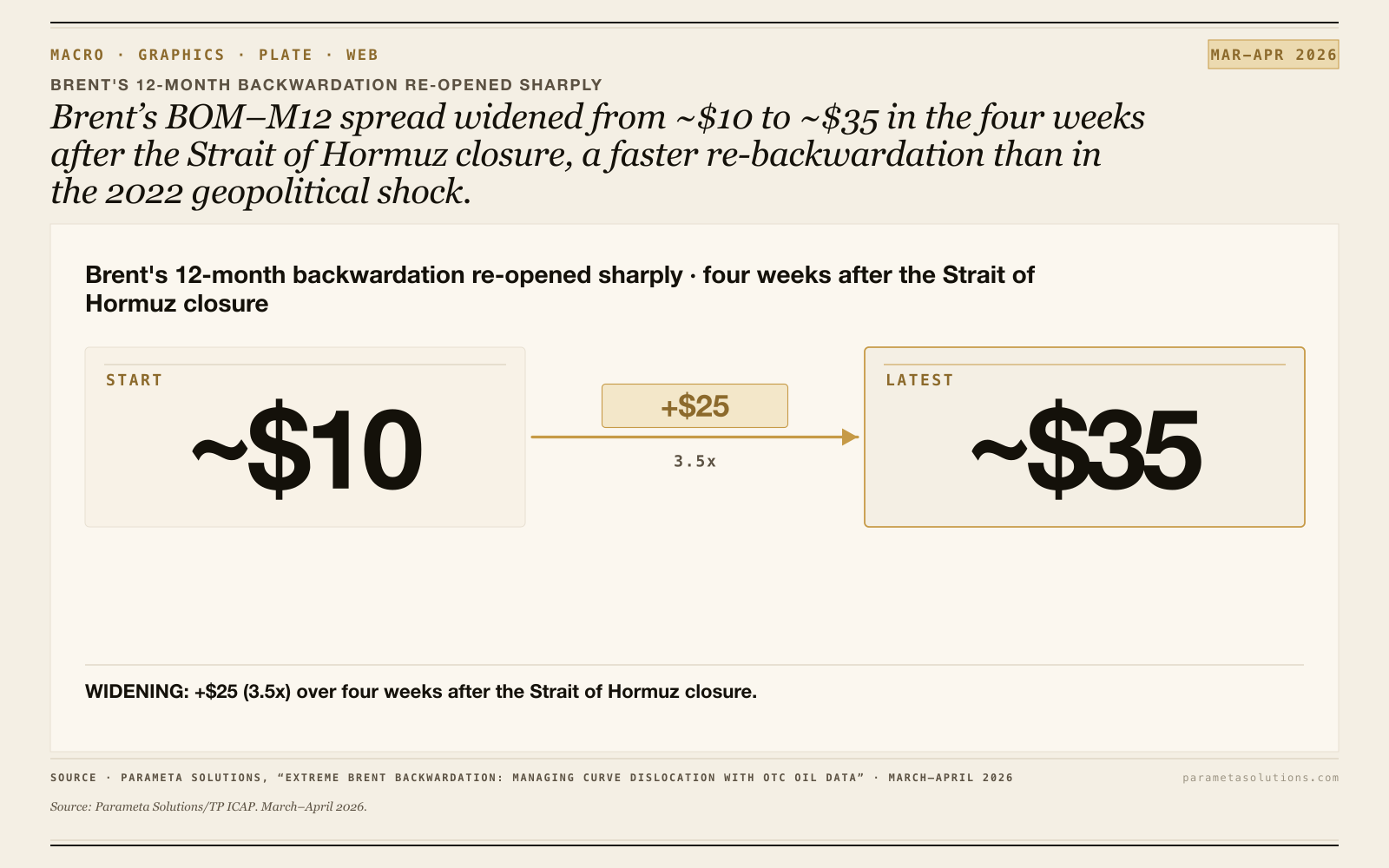
  9. Snapshot card showing that Brent's BOM–M12 spread widened from about $10 to about $35 in the four weeks after the Strait of Hormuz closure, a faster re-backwardation than during the 2022 geopolitical shock.
    Plate 03

    Brent Front-End Re-Steepened by Apr. 10

    Parameta's public April 10 note shows Brent's BOM-M12 spread moving from about $10 in early March to about $35 by April 10.
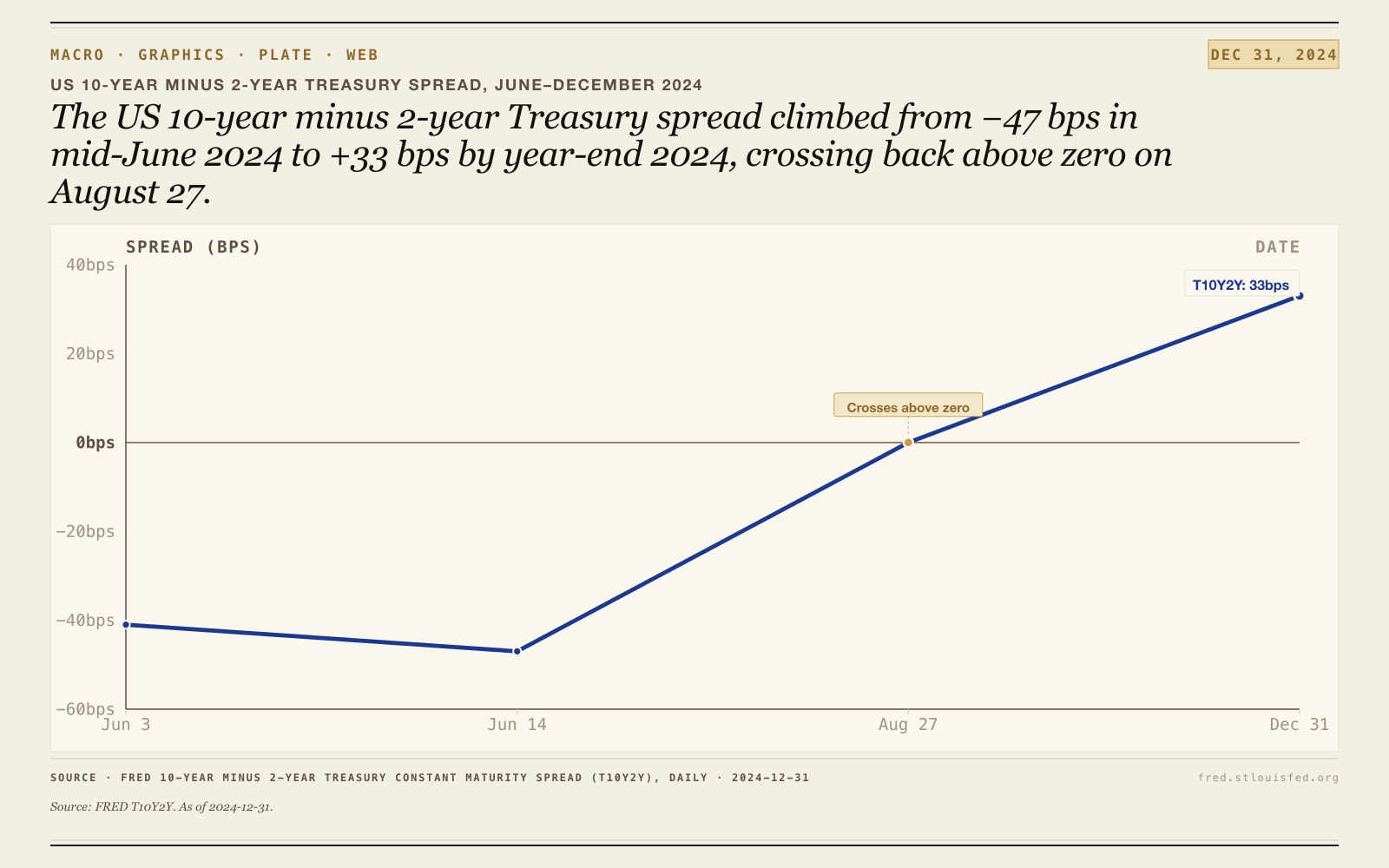
  10. Line chart showing the US 10-year minus 2-year Treasury spread rising from −47 bps in mid-June 2024 to +33 bps by year-end, crossing above zero on August 27.
    Plate 02

    Treasury spread turns positive again

    The spread moved from −47 bps on 2024-06-14 to 0.00 bps on 2024-08-27 and finished at +33 bps on 2024-12-31.
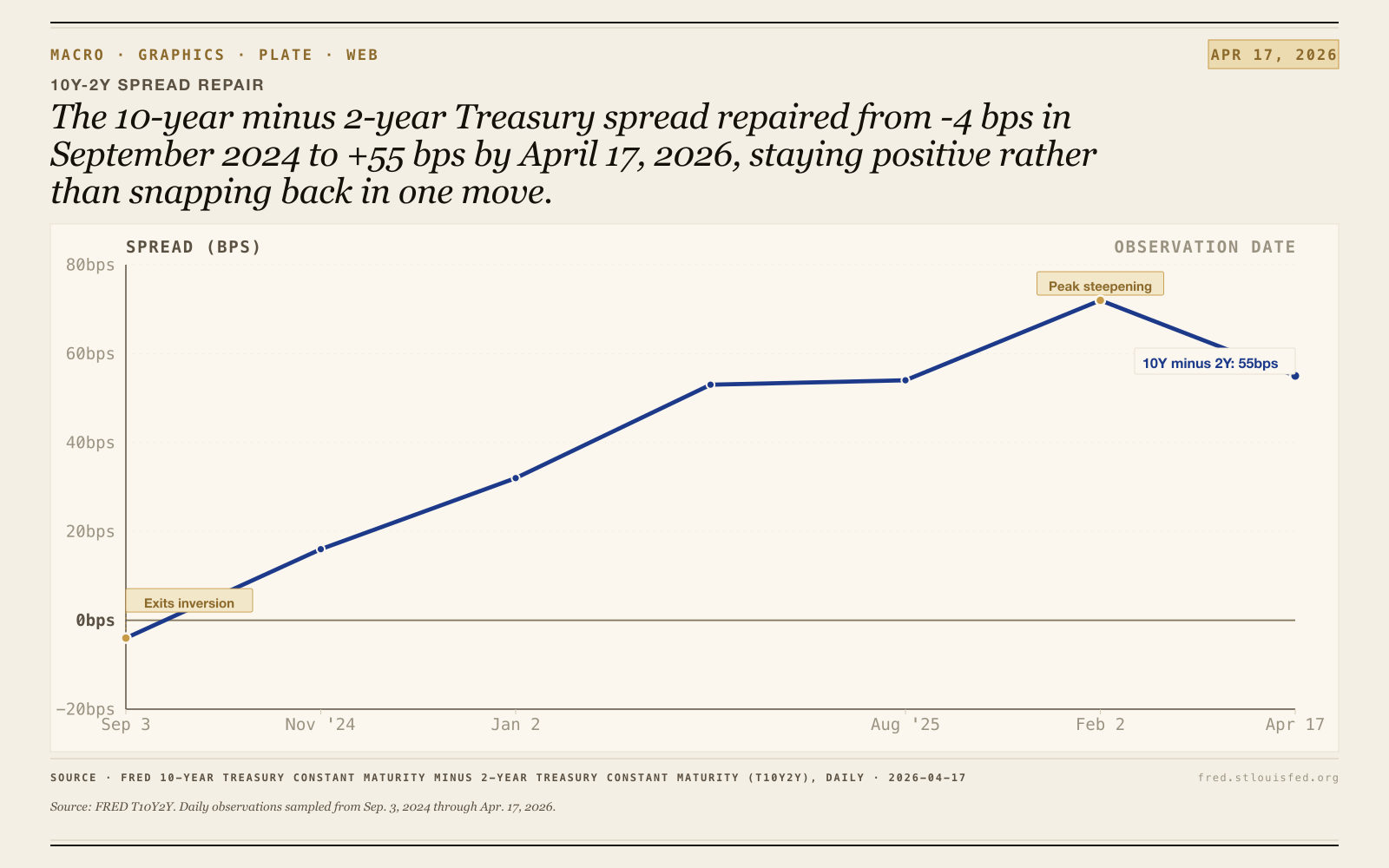
  11. Line chart showing the 10-year minus 2-year Treasury spread rising from -4 basis points in September 2024 to +55 basis points by April 17, 2026 after peaking near +72 basis points in February.
    Plate 01

    10-Year minus 2-Year spread climbs higher

    The 10-Year minus 2-Year Treasury spread is climbing higher in recent months, and the chart reads less like a snapback than a patient repair.